Flock Safety and digital privacy

A vendor login is not probable cause.

Flock cameras can turn an ordinary drive into a searchable record of where we go. Government should not be able to buy or pool that record to get around the Fourth Amendment.

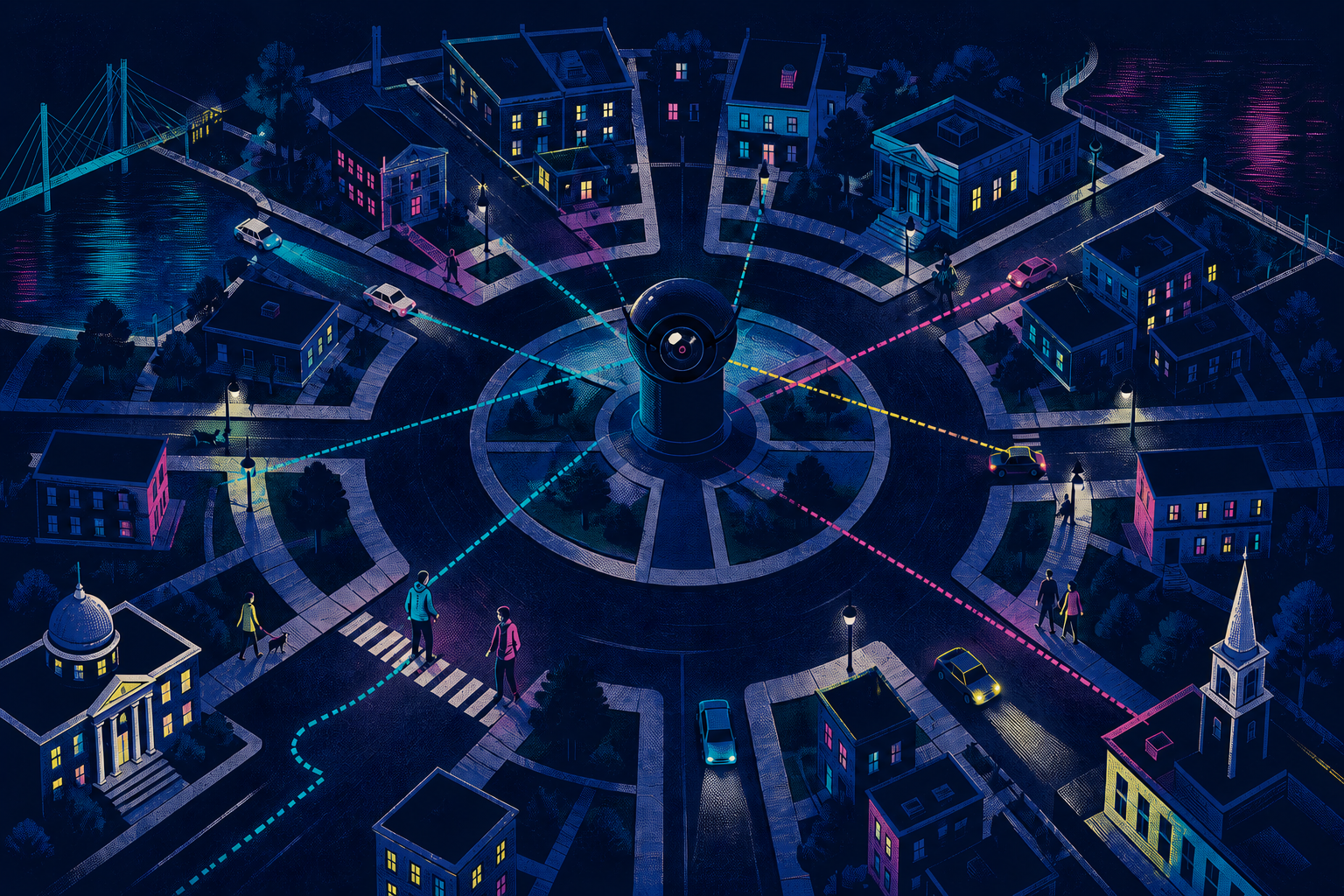
Contemporary campaign illustration of a neighborhood surrounding a central observation tower
This is campaign art, not an archival image or a reconstruction. The giant people should be a dead giveaway.

Most people do not think of a trip to work, school, church, the doctor, or a political meeting as a trail of evidence. A networked plate reader can make it one: plate, vehicle, place, and time, available for later search.

The picture is new. The problem is not. In the 1780s, the English philosopher and legal reformer Jeremy Bentham was designing the panopticon—what he thought could be the perfect prison: a ring of cells around a watchtower, where prisoners could never know when they were being watched. The uncertainty did the work; the mind became its own prison guard.

Michel Foucault, a French historian and philosopher writing almost two centuries later, explained the larger danger: the same logic could spread through schools, workplaces, hospitals, and the state, teaching people to police themselves because observation was always possible.

Flock didn't invent the problem—it just gave it searchable vehicle records. A Wisconsin criminal complaint filed in July 2026 says an internal audit found three searches of one plate and seventeen of another, and alleges that an officer admitted using Flock to track two people in violation of policy. A complaint is not a conviction, but the audit and allegations make the risk crystal clear.

Ratified Fourth Amendment linework: persons, houses, papers, and effects

This is already here

EFF reports that Delaware State Police searched Flock's national network nine times in March 2025 in connection with Direct Action Everywhere activity. The public source does not establish the legal predicate, who approved the searches, or what came of them. That uncertainty is part of the problem: people should be able to know the rules under which their movements become searchable.

Write the rules now

We do not have to wait for every court to draw the outer boundary. I would require warrants for aggregated historical or sensitive searches, short retention, strict limits on sharing, case-linked audit trails, public disclosure, human review before a plate match triggers action, and a real way to challenge misuse.

The Fourth Amendment already applies. New machinery does not erase an old right. My judgment is that government purchase and pooling of movement records can become a shortcut around the fence the Fourth Amendment erects. Courts should enforce the right robustly rather than let exceptions and constructive distortions swallow it.

Then we should make the protection explicit and durable. We can pass a digital-rights amendment covering purchased, pooled, aggregated, and third-party-held records—not to invent the right, but to protect it from corruption and erosion as the machinery changes.

Protect the Fourth Amendment.

Extend it 250 years forward.
Compact source drawer

How the technology works

Delaware and documented misuse

The old rule and the new machinery

Explore reported cameras

  • DeFlock map — crowdsourced and possibly incomplete or outdated; a marker does not prove current ownership/use, and an absent marker does not prove no camera exists. The project does not endorse Jeff.